
PROCESS OPTIMIZATION METHODS


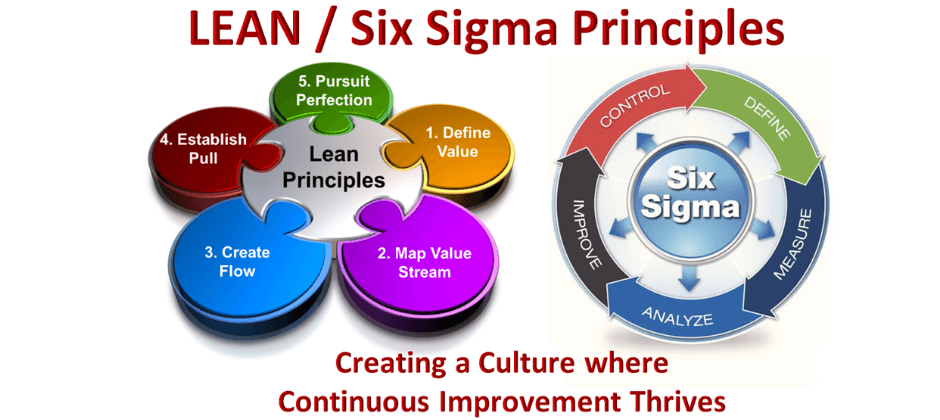

Lean Management
Lean Management: the concept of “lean” was coined by John Krafcik, who first used it in 1988 in his article published in the “Sloan Management Review”. The concept was then popularized by a group of scientists from the Massachusetts Institute of Technology, James Womack, Daniel Jones and Daniel Roos, who in 1990 published the famous work “The Machine That Changed the World”. They recognized the Japanese company Toyota Motor Corporation with the Toyota Production System as the leader. The authors considered this system the first lean manufacturing system and called it lean manufacturing. However, before Toyota appeared, in 1913 Henry Ford created flow production, i.e. he introduced assembly lines for cars. The Model T revolutionized the manufacturing system and gave rise to smooth production.
Lean Management tools:
- VSM – Value Stream Mapping; the goal is to collect data on the actual flow of physical elements and information.
- 5S – a method of systematic learning, discipline, standardization and striving for perfection. It involves performing 5 steps: Sort, Systematize, Sweep, Sanitize, Self-discipline.
- TPM – Total Productive Maintenance – Optimal Maintenance; the goal is to ensure maximum availability of critical devices.
- SMED – Single Minutes Exchange of Die – reduction of machine changeover time; the goal is to perform only absolutely necessary work during changeovers.
- Just In Time (JIT) [on-time delivery] – one of the techniques used in quality management regarding production, the essence is to import component parts exactly at the moment when they can be used for production.
- KAN BAN => card-signal: a method developed in 1947 in Japan by Toyota, a decentralized production management concept, a system for planning and controlling the production flow, supporting the functioning of JIT, the reverse flow of goods and information – contract production.
SMED
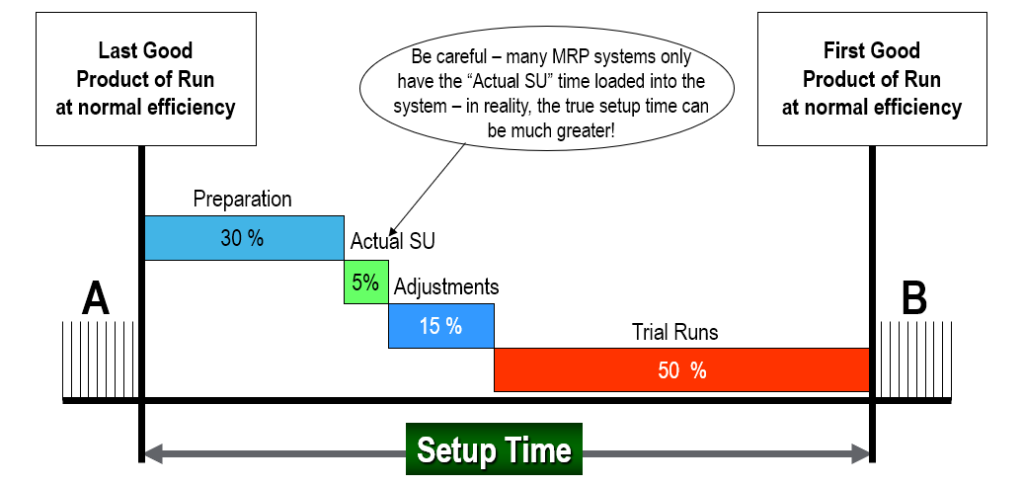
SMED (Single-Minute Exchange of Die) is a production optimization method. Its purpose is to shorten the tool replacement time. The key idea of SMED is to divide tool change time into two categories: internal time and external time.
1. Retooling / changing internal tools:
– assembly and disassembly performed only when the machine is standing.
2. Retooling / changing external tools:
– operations such as transporting the replaced tooling to the warehouse, delivering new equipment, heating the mold, etc. can be performed while the machine is running
Conceptual stages of streamlining changeover:
Stage 0 – Distinguishing external from internal reinforcement
Stage 1 – Separation of external and internal reinforcement
Stage 2 – Changing the internal to external reinforcement
Stage 3 – Streamlining and improvement of all elements of the new rearmament
Ways to reduce changeover time:
1. Eliminating unnecessary operations
2. Changing internal to external activities
3. Elimination or simplification of all regulations and settings
4. Changing connections, e.g. screws to quick connectors
5. Minimization of start-up time after changeover
6. Verify the possibility of performing the operation in parallel
7. Improve machines and tools
8. Verify the order of operations
SIX SIGMA
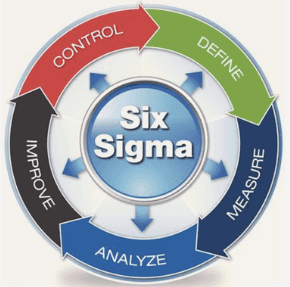
Six Sigma is a quality management strategy that aims to improve processes by eliminating defects and reducing variability. The name “Six Sigma” refers to the statistical concept of standard deviation (sigma), and achieving the Six Sigma level means a very low defect rate, close to zero.
The main principles and elements of Six Sigma include:
1. Define: Determining the project goals, scope and identifying stakeholders.
2. Measure: Collect data about the current process to determine its performance.
3. Analyze: Analyze data to identify potential causes of problems and defects.
4. Improve: Making changes to improve the process.
5. Control: Maintaining and monitoring changes made to ensure continuous improvement.
Implementing Six Sigma can bring a number of benefits to an organization, such as increasing efficiency, reducing costs, improving customer satisfaction, and focusing on customer-relevant results. The key to success is the systematic application of the methodology and the involvement of the entire organization in striving for process perfection. Improper application of Six Sigma strategies can stifle innovation and may have a negative impact on employee morale.